
- News
- City News
- noida News
- Covid evenly spread out across Uttar Pradesh but testing shows wide variations
Trending
This story is from September 5, 2020
Covid evenly spread out across Uttar Pradesh but testing shows wide variations
It has been six months since Uttar Pradesh performed its first Covid-19 test and recorded its first infection, in a man in Ghaziabad.
Representative image

Its estimated population of 22.4 crore means UP ranks among the lowest in the key testing parameter — people tested per lakh population (testing rate, from here on). At 2,698, UP’s testing rate is higher only than those of Madhya Pradesh, West Bengal, Chhattisgarh and Jharkhand. The three large states ahead of UP in total caseload all have higher testing rates — Maharashtra (3,588), Tamil Nadu (6,667) and Karnataka (4,747).
In the last 30 days, more people were tested (34 lakh) in the state than the previous months combined. As the number of tests increase, the macro testing rate, too, is expected to rise over the next few weeks. But what will need a closer look is the wide variations in the micro testing rates of districts across the vast geographical sweep of the state, even though the pandemic’s reach is now almost uniform — only 11 of the state’s 75 districts have recorded less than 1,000 cases.
Districts in the west and central regions that comprise NCR and most of the state’s main urban centres account for almost half (47%) of all the tests done in the state. Purvanchal, where two of the top six hotspots now in terms of active cases — Gorakhpur and Varanasi — are located, has a testing share of 23%.
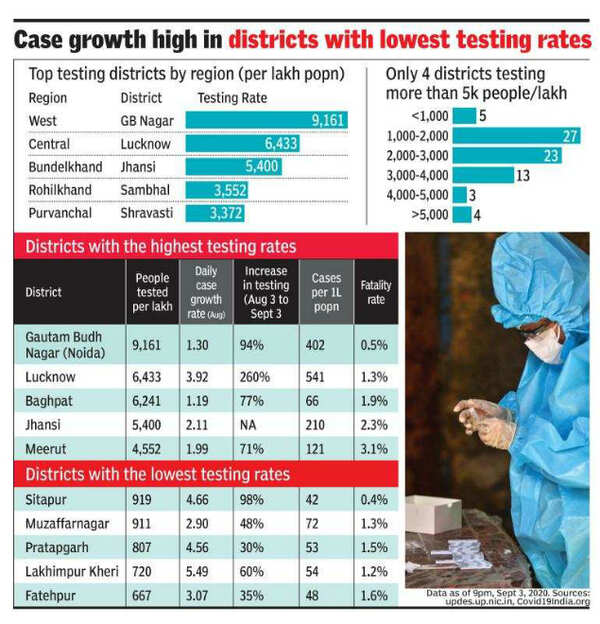
The disparity becomes more conspicuous when parsed district-wise — only a third of the districts are testing more than the state average of 2,698. And those with the highest testing rates are not necessarily the biggest hotspots at present.
Take Gautam Budh Nagar (Noida), for instance. The NCR district, UP’s industrial capital for all practical purposes, leads in testing rate (9,161). GB Nagar was UP’s main Covid hotpsot for months as cases rose in tandem with Delhi. Consequently, it started testing more aggressively.
On the active cases dashboard at present, GB Nagar ranks 12th. But the five districts currently with most active cases have significantly lower testing rates — Lucknow (6,433), Kanpur Urban (3,536), Parayagraj (1,758), Gorakhpur (1,485) and Varanasi (2,740). Meanwhile, Baghpat has the third-best testing rate in UP (6,241), though the second-fewest active cases.
The least testing district is Fatehpur (667), though it has more active cases than 25 UP districts. Fatehpur is testing 14 times fewer people per lakh population than Noida. Agra, which has the highest case fatality rate (3.5%) in the state, has a testing rate of 2,450 — less than a third of Noida.
Other than Fatehpur, the four other districts at the bottom of the testing pack are Lakhimpur Kheri, Pratapgarh, Muzaffarnagar and Sitapur — all testing less than 1,000 people per lakh population. The testing rate in these five districts remained low despite the infection spreading faster in three of these places — Lakhimpur Kheri, Sitapur and Pratpgarh — faster than in most other districts in August. Lakhimpur Kheri, in fact, had the highest daily growth rate (5.49%) last month.
While growth in overall tests conducted was over 100% in August, this addition, too, was distributed unevenly. Testing in Pratapgarh grew the least (35%) over a one-month period (Aug 3-Sept 3) compared to all other UP district, while that in around 50 districts doubled or quadrupled.
End of Article
FOLLOW US ON SOCIAL MEDIA






Hot Picks
TOP TRENDING
Trending Stories
In City
Entire Website
- Breathtaking cosmic catwalk! SpaceX makes history with first-ever private spacewalk
- 2 Army officers thrashed, their female friend gang-raped in Madhya Pradesh
- Bangladesh announce Test squad for India tour
- Top fastest trains in the world: From China's CR Harmony to Germany's ICE
- Amid Shannon Sharpe Viral Video, Former ESPN Host Michelle Beadle Reacts Claiming It Was Not Her
- Ayushman Bharat insurance scheme expanded to cover elderly above 70
- 'Will be demolished if... ': Himachal minister's assurance amid Shimla mosque row
- Mumbai's Haji Ali and Mahim dargahs cancel Eid shamiana
- Garena Free Fire MAX redeem codes for September 11, 2024: Win free room cards, skins, diamonds, pet skins, and more rewards today
- GK for students: Top 8 Largest Mammals in the World
- Bulldozer justice like bulldozing laws of land: Supreme Court
- No ‘Padmar ilish’ in Kolkata this Puja as B’desh stops Hasina’s ‘hilsa diplomacy’
- Why you should not be fooled by ‘20-year SIP crorepati’ dream
- India, China to work urgently for disengagement in Ladakh
- Virat & Rohit's successors: India cricketer picks these two 'special players'
- Pakistan stand-off over cops seeking army exit from restive province drags on
- Your cousin’s poo can now cure your chronic stomach problems
- iPhone 16 to go on pre-order today: Details, time, sale date and more
- Karthik predicts India's dominance despite B'desh's success against Pak
- Govt to develop Mausam GPT in 5 years to share weather information

Popular Categories
Hot on the Web
Top Trends
Trending Topics
Alia BhattMalaika Arora Father DeathArbaaz KhanNatasa StankovicMr Bachchan OTT ReleaseNational Parks In IndiaSelena GomezGOAT CollectionVikas Sethi DeathMalayalam ProducersIndia's Best Dancer 4Simi GarewalDilli BabuIndian National ParksLaung BenefitsVikas SethiiPhone 16Microsoft 365 OutageCsir Ugc Net 2024Wordle Answer
Living and entertainment
Latest News
India successfully flight tests surface-to-air missileFintech Moneyview turns unicorn, 6th one this yearDigest this: Unhealthy gut may be linked to Parkinson’s diseaseCSIR UGC NET 2024 result declared: Steps to download scorecards at csirnet.nta.ac.inWhat are lucid dreams? Exploring the science, benefits, and techniquesWho was Illia 'Golem' Yefimchyk, the Belarusian bodybuilder who consumed 2.5 kg of meat and 108 sushi pieces daily before his death at 36?Vijay Varma reveals he was DROPPED from 'Sacred Games' at the last minuteWWE Star Discusses Why Sid Vicious Deserves a Hall of Fame SpotFriendly nations helped Pakistan meet IMF bailout conditions, says PM Shehbaz SharifCatching up with sports stars in DelhiSalman Khan surrounded by bodyguards as he arrives at Malaika Arora's mother's house to offer his condolences - WATCHCMF Buds Pro 2 by Nothing review: Big delivery on a budgetMallika Sherawat makes big screen comeback in Rajkummar Rao's 'Vicky Vidya Ka Woh Wala Video'; director reveals why he cast herArbaaz Khan spotted outside Malaika Arora's house along with police after the tragic news of her father's demise by alleged suicide - WATCH VIDEOHarvey Weinstein charged with additional crimes during hearing on rape chargesMitchell Schwartz's Cryptic Tweet Stirs Debate About Mahomes' ContractSiddhant Chaturvedi reveals he rejected Ranbir Kapoor, Alia Bhatt and Amitabh Bachchan starrer Brahmastra after father’s advice: 'He asked me, ‘Tujhe kaun dekhega?''EcoR unloads 100 million tons of goods in just 160 days
Copyright © 2024 Bennett, Coleman & Co. Ltd. All rights reserved. For reprint rights: Times Syndication Service